Wednesday, March 04, 2009
Old Books
While reading "Reading Between the Lines", I was reminded of Lewis's advice that one out of every four books should be outside of your own time, and since you cannot read future books, you should read ones from the past. My last few books have been from within my time. Currently I am working on Doing Our Own Thing by John McWhorter, Reading Between the Lines by Gene Edward Veith Jr. I have recently read, Culture Making by Andy Crouch, Our Magnificent Bastard Tongue by John McWhorter To Kill a Mocking Bird by Harper Lee. My Grandfather's Son by Clarence Thomas, Assumptions that Affect our Lives by Christian Overman. I think it is time for an older book. While I really want to read Dickens or Dostoevsky, I am leaning toward Pride and Prejudice by Jane Austin and it is time for me to read Calvin's Institutes.

Wednesday, February 25, 2009
Gold Investment
If gold is such a good investment right now, what idiot is selling their gold to all these new people? Can you say B-u-b-b-l-e ?
Wednesday, February 18, 2009
Expelled: Again
In World Magazine's Human Race section, they report that Ben Stein
Curiously, Stein's main point in "Expelled: No Intelligence Allowed" was that proponents of Intelligent Design are kicked out of the establishment and marginalized for their views rather than debated in the marketplace of ideas, which is exactly what happened here. He may have spoken on economics, but the dissenters insisted on proving his point.
withdrew as the University of Vermont's spring commencement speaker after the school received a flood of complaints, including one from evolutionist Richard Dawkins.
Curiously, Stein's main point in "Expelled: No Intelligence Allowed" was that proponents of Intelligent Design are kicked out of the establishment and marginalized for their views rather than debated in the marketplace of ideas, which is exactly what happened here. He may have spoken on economics, but the dissenters insisted on proving his point.
Wednesday, February 11, 2009
Wednesday, January 14, 2009
Questions for Cultural Artifacts
I have started to read "Culture Making" by Andy Crouch. In the first chapter he mentions five questions to be asked about cultural artifacts that I find to be a revealing and worthy excercise.
1. What does this cultural artifact assume about the way the world is.
2. What does this cultural artifact assume about the way the world should be?
3. What does this crultural artifact make possible?
4. What does this cultural artifact make impossible (or at least very difficult)?
5. What new forms of culture are created in response to this artifact?
1. What does this cultural artifact assume about the way the world is.
2. What does this cultural artifact assume about the way the world should be?
3. What does this crultural artifact make possible?
4. What does this cultural artifact make impossible (or at least very difficult)?
5. What new forms of culture are created in response to this artifact?
Thursday, December 11, 2008
New Links
I am updating my links based on the blogs I have been reading that I find helpful.
Popular Mechanics has a lot of helpful tips (especially for men) and even had an article a while back that discredited much of the 911 conspiracy theory. There is an extensive archive of the old issues here.
Works and Days is a social commentary by historian Victor Davis Hanson. He has written quite extensively on classical history and history of war. You might call him a conservative. He has more articles here.
Greg Mankiw wrote my Economics textbook (Mine is an earlier edition). Brilliant man. I am not sure were he leans politically, but he makes a lot of sense and can dumb things down for the rest of us.
Ben Stein. Need I say more? Ok, Ben Stein on economics.
Instapundit being mostly political (with some entertainment mixed in) and leaning conservative. Updated very frequently.
22 Words is Abraham Piper's blog of brevity. He tends to be thoughtful and his topic range is wide.
Popular Mechanics has a lot of helpful tips (especially for men) and even had an article a while back that discredited much of the 911 conspiracy theory. There is an extensive archive of the old issues here.
Works and Days is a social commentary by historian Victor Davis Hanson. He has written quite extensively on classical history and history of war. You might call him a conservative. He has more articles here.
Greg Mankiw wrote my Economics textbook (Mine is an earlier edition). Brilliant man. I am not sure were he leans politically, but he makes a lot of sense and can dumb things down for the rest of us.
Ben Stein. Need I say more? Ok, Ben Stein on economics.
Instapundit being mostly political (with some entertainment mixed in) and leaning conservative. Updated very frequently.
22 Words is Abraham Piper's blog of brevity. He tends to be thoughtful and his topic range is wide.
Friday, December 05, 2008
On the "definition" of insanity.
Being once again irritated by the false definition of insanity, I hereby declare it a clichéd metaphor. Not only is this not a definition put forth by a psychologist, it is also misattributed to other non-psychologists like Albert Einstein and Benjamin Franklin. According to Wikiquote, it was first recorded by the author Rita Mae Brown in the novel Sudden Death. Everyone knows that it is often foolish to use methods that have proved to fail, but the concept can be used prematurely to mock things that take time, perseverance, maintenance, and hope. It can also bring about cynical attitudes toward preventative measures that help but do not solve the problem. See the last paragraph in this article by Ed Morrissey on the war on drugs. Since brushing my teeth did not stop some cavities in the past, shall I stop brushing?
Friday, November 14, 2008
Bugs on a Tree
Heather recently recorded these on a tree in our backyard. Does anyone know what they are? If not, I will take suggestions for naming them...
Sunday, September 28, 2008
Economy
I find a lot of this financial crisis news confusing. I had never even heard of Fanny and Freddie before, nor the Lehman Brothers. But in the midst of the falling sky there are two things that I never hear said.
The first is that the falling of house prices is great for buyers. The falling prices are not good for the subprime mortgage lenders when borrowers bail out, nor for people who recently bought a house and sell soon after. If I sold my house now, I would lose money because my house is worth less now than when I bought it (with maintenance and interest in top of it). Since I am not selling, I don't really care. Theoretically, this would reduce my property tax. And by the time I do sell, my house will probably be worth more than I paid for it, though perhaps not in proportion to inflation.
The second is that the people who really benefitted from the housing bubble are sellers. Ok, the lenders where getting checks during this time, too, but they are the ones losing money in this whole deal. Real Estate Agencies were booming as well, but I would imagine that many agents are out of a job right now, or looking for a new one. The same for developers; it does no good to develop when it won't sell. That said, in the past ten years, sellers upgraded and are enjoying the fruits of their bigger, fancier house.
So, whats the problem? The fear is that it will be very hard for people and businesses to get loans, unless there is a government bailout. When its harder to get loans, less people buy (like houses) or start up businesses which in turn hire people which in turn buy (like houses) and make the economy go around.
The first is that the falling of house prices is great for buyers. The falling prices are not good for the subprime mortgage lenders when borrowers bail out, nor for people who recently bought a house and sell soon after. If I sold my house now, I would lose money because my house is worth less now than when I bought it (with maintenance and interest in top of it). Since I am not selling, I don't really care. Theoretically, this would reduce my property tax. And by the time I do sell, my house will probably be worth more than I paid for it, though perhaps not in proportion to inflation.
The second is that the people who really benefitted from the housing bubble are sellers. Ok, the lenders where getting checks during this time, too, but they are the ones losing money in this whole deal. Real Estate Agencies were booming as well, but I would imagine that many agents are out of a job right now, or looking for a new one. The same for developers; it does no good to develop when it won't sell. That said, in the past ten years, sellers upgraded and are enjoying the fruits of their bigger, fancier house.
So, whats the problem? The fear is that it will be very hard for people and businesses to get loans, unless there is a government bailout. When its harder to get loans, less people buy (like houses) or start up businesses which in turn hire people which in turn buy (like houses) and make the economy go around.
Monday, September 22, 2008
Thursday, September 04, 2008
Media Bias in Plain Sight
I thought this was a clear display of media bias in at least one magazine, tabloid or not.
Monday, July 28, 2008
Passed Away
My Dad passed away on Saturday from liver problems. Your prayers are appreciated for my family.
Tuesday, April 08, 2008
Readings
For the past few months, I have been working my way through some theological books on Genesis, taking note of some insights and distinctions in interpretation.
 #1 Rethinking Genesis is an exploration of the literary origins of Genesis, specifically a refutation of the Documentary Hypothesis which is flawed from its roots. Garrett takes a look at the different styles and genres in Genesis, and notices distinct patterns which point to the book's sources which he concludes were redacted by Moses.
 #2 The Pentateuch as Narrative, I have only just started reading. It seems intriguing as it examines the relation between whole Pentateuch. How the different parts relate will influence how we interpret the text.
 #3 God's Pattern for Creation is a fresh look at the creation story in light of man being made in God's image. God created the universe by forming it and filling it. In the same way, God commanded us to rule over the creation (forming) and to reproduce (filling). After the fall, God cursed our role by cursing the ground (making our forming more difficult) and increasing the pains of childbirth (making our filling more difficult).
 #4 How to read Genesis did not really stand out in my mind, but it was a good overview of Genesis and is a helpful introduction to the book for those who are not familiar with it.
 #5 Creation and Blessing, I am still working through, but it appears to trace certain themes throughout the book of Genesis. Nothing overly inciteful has come up yet, but I still have 500 pages to go.
 #6 Genesis 1-4: A Linguistic, Literary, and Theological Commentary introduces a methodology of interpreting story from a linguistic basis. Essentially, there is a change in verb tense from when a story is being set up or background information is being established, to when the story is being told. There were many other insights involved with this too numerous for this space.
From here I will be finishing some introductions to a couple of books, namely the Pentateuch as Narrative and the Holman Bible Atlas and will proceed to read through Genesis (and later the whole Pentateuch) along with the following books as they go in chronological order, Sailhammer's Pentateuch as Narrative, Brisco's Holman Bible Atlas, Vos's Biblical Theology, Josephus's Works and Ross's Creation and Blessing. I also have a friend who just wrote a book that I will add to the list. It is not for sale, yet and I do not remember what it was called. It has to do with Jesus in the Old Testament. After Genesis, I will drop Creation and Blessing since that will be finished and I will continue with the others adding Riddle of the Exodus by James D. Long and The Structure of Biblical Authority by Meredith G. Kline. After I finish the Pentateuch, I will reevaluate where I go from there. I will be done with my Greek course and will have more time to study my own interests. I may just continue my way through the rest of the Bible as Vos, Josephus, and Brisco go the whole way.
 #1 Rethinking Genesis is an exploration of the literary origins of Genesis, specifically a refutation of the Documentary Hypothesis which is flawed from its roots. Garrett takes a look at the different styles and genres in Genesis, and notices distinct patterns which point to the book's sources which he concludes were redacted by Moses.
 #2 The Pentateuch as Narrative, I have only just started reading. It seems intriguing as it examines the relation between whole Pentateuch. How the different parts relate will influence how we interpret the text.
  #3 God's Pattern for Creation is a fresh look at the creation story in light of man being made in God's image. God created the universe by forming it and filling it. In the same way, God commanded us to rule over the creation (forming) and to reproduce (filling). After the fall, God cursed our role by cursing the ground (making our forming more difficult) and increasing the pains of childbirth (making our filling more difficult).
  #4 How to read Genesis did not really stand out in my mind, but it was a good overview of Genesis and is a helpful introduction to the book for those who are not familiar with it.
  #5 Creation and Blessing, I am still working through, but it appears to trace certain themes throughout the book of Genesis. Nothing overly inciteful has come up yet, but I still have 500 pages to go.
 #6 Genesis 1-4: A Linguistic, Literary, and Theological Commentary introduces a methodology of interpreting story from a linguistic basis. Essentially, there is a change in verb tense from when a story is being set up or background information is being established, to when the story is being told. There were many other insights involved with this too numerous for this space.
 From here I will be finishing some introductions to a couple of books, namely the Pentateuch as Narrative and the Holman Bible Atlas and will proceed to read through Genesis (and later the whole Pentateuch) along with the following books as they go in chronological order, Sailhammer's Pentateuch as Narrative, Brisco's Holman Bible Atlas, Vos's Biblical Theology, Josephus's Works and Ross's Creation and Blessing. I also have a friend who just wrote a book that I will add to the list. It is not for sale, yet and I do not remember what it was called. It has to do with Jesus in the Old Testament. After Genesis, I will drop Creation and Blessing since that will be finished and I will continue with the others adding Riddle of the Exodus by James D. Long and The Structure of Biblical Authority by Meredith G. Kline. After I finish the Pentateuch, I will reevaluate where I go from there. I will be done with my Greek course and will have more time to study my own interests. I may just continue my way through the rest of the Bible as Vos, Josephus, and Brisco go the whole way.
Friday, February 01, 2008
Details...
Judah was born on January 21, 2008. It was Monday morning. Heather's water broke at 8:00AM and we rushed over to the hospital after making arragements for our dog. She didn't start to have contractions until we arrived at the hospital. At the start Heather was determined to not have meds, but when the pain started to increase, the idea of pain killer started to become more desireable, moreso because the idea of several more hours of the pain appeared unbearable. The nurse brought in the epidural and made a call to the anesthesialogist. When the nurse checked Heather's dialation, we discovered that she was 100% dialated and that the epidural would not be happening. This was not what Heather wanted to hear. Since the time to start pushing had arrived there was nothing she could do. Heather did not have stirrups, so I held one leg and the nurse held the other. I was a bit concerned because we only had one birthing class. The doctor/nurse told us that the pushing would feel like and be similar to going #2. When Judah came out, it appeared that he was spring loaded. Fortuneatley, the doctor caught him. I had the privilage of cutting the umbilical cord and calling the gender, and I did both things right.
Judah was wisked away to NICU and Heather was given a room for recovery. Heather was out in two days. Judah is progressing. First he got off the respirator. Then he no longer needed an IV. After that they stopped monitoring his blood oxygen levels. His light and incubator were the next to go. Now his is in a crib with a heart and repiriratory sensor and a feeding tube. He has been nursing minimally for the past week, and has been progressing in his capacity.
We are both looking forward for the day when he comes home. But we are both very thankful for the grace God has given us and that there have been no complications.
Judah was wisked away to NICU and Heather was given a room for recovery. Heather was out in two days. Judah is progressing. First he got off the respirator. Then he no longer needed an IV. After that they stopped monitoring his blood oxygen levels. His light and incubator were the next to go. Now his is in a crib with a heart and repiriratory sensor and a feeding tube. He has been nursing minimally for the past week, and has been progressing in his capacity.
We are both looking forward for the day when he comes home. But we are both very thankful for the grace God has given us and that there have been no complications.
Thursday, January 24, 2008

Tuesday, November 20, 2007
Good News for Embryos
Apparently this research makes the current embryonic stem cell debate obsolete. Somehow I remember hearing the news before, but this article gives perspectives from the discoverer of embryonic stem cell research, and the cloner of the Dolly sheep giving credibility to the notion that cloning and embryo destruction are not necessary to gain the health research advances so many have been longing for.
Saturday, September 08, 2007
Mac Service
I had been experiencing problems with my Mac for a long time. Some of them I just took for granted as being software or limited power abilities in the computer. When my computer stopped turning on, I knew there was a much deeper problem. I was concerned that a fix would be a couple hundred dollars. I ended up taking my computer in, and it turns out it was a common power connection burnout. They replaced the part and I am back in business. My problems that are fixed are as follows:
-Power being unavailable for my Flash and Photo drives to plug in the keyboard
-My computer being unable to wake up after going to sleep
-My computer turning off randomly
Unfortunately, my DVD ROM is not fixed, but I can live without that.
-Power being unavailable for my Flash and Photo drives to plug in the keyboard
-My computer being unable to wake up after going to sleep
-My computer turning off randomly
Unfortunately, my DVD ROM is not fixed, but I can live without that.
Monday, August 13, 2007
Hard Times
I recently finished Hard Times by Charles Dickens. It was a delight to read as Dickens makes fun of what I think is called Pragmatism. I found the book funny and insightful. My only complaint is that I did not see poetic justice. Yes, the bad guys lose or reform in the end, but those who are wronged are not righted. Despite this minor annoyance, the characters are rich and engaging.
Saturday, June 02, 2007


Saturday, May 19, 2007
Grass
Here is how the grass is progressing. Looks good to me. Might need to add some seed to fill in some holes, but it looks great.

I made a workbench. It's my first one. I may make some modifications, but it will work for my purposes. I am hoping to make some book shelves next.

Here is a spring shot of our backyard. That is our house in the distance. We are hoping to axe the tree in the near future to let more sun in and prevent it from falling on our house in the event of a windstorm.

These are some mushrooms I found in our yard. They have probably been mowed over by now, but I didn't hesitate to take a few pictures. Does anyone know if these are edible?


I made a workbench. It's my first one. I may make some modifications, but it will work for my purposes. I am hoping to make some book shelves next.

Here is a spring shot of our backyard. That is our house in the distance. We are hoping to axe the tree in the near future to let more sun in and prevent it from falling on our house in the event of a windstorm.

These are some mushrooms I found in our yard. They have probably been mowed over by now, but I didn't hesitate to take a few pictures. Does anyone know if these are edible?

Monday, May 07, 2007
Happenings at Home
I have been planting grass. It works well to plant one area at a time so it does not become a time burden.

I have also sighted a few birds.


We had some visitors from the Dominican Republic last week. They were attending the Desiring God Children's Conference. Two spoke English quite well, and two hardly at all. We hope they enjoyed their stay.


I have also sighted a few birds.


We had some visitors from the Dominican Republic last week. They were attending the Desiring God Children's Conference. Two spoke English quite well, and two hardly at all. We hope they enjoyed their stay.

Thursday, May 03, 2007
New Job
Starting Monday, I will be working for DLR in Eden Prairie.
Heather is waitressing for the Macaroni Grill.
More to come...
Heather is waitressing for the Macaroni Grill.
More to come...
Thursday, March 08, 2007
Review of Melville
At long last I managed to finish Moby Dick, so now it is time for its review.
In short, I do not recommend this book unless if you are curious to know every facet of the anatomy of the sperm whale. It seems to me that Melville sandwiched his fascination for whales between a meager 200 pages of plot--making what could have been a quick read into a 724 page monster.
Now, don't get me wrong, the whale anatomy and details of the whaling business were interesting, to a point. But I would be lying if I did not confess that the quantity of those "informative" chapters caused me to lose interest in the book, made it hard to keep track of the plot, and made me lose my appetite and become nauseous during the graphic blubber-processing chapter. I give it 3 stars out of 10.
Turning now to the theological; the beginning of the book had an interesting portion that had very shady and heretical implications. The narrator, Ishmael, has made friends with a "pagan" harpooner named Queequeg. After Ishmael has once observed Queequeg worshipping his idols, he dialogs with himself concerning his own Christian duties in relation the the "pagan".
I think I will try to finish Owen's Temptation & Sin before I go on to anything more. Having been spoiled by Victor Hugo and John Steinbeck, I think I need a break from fiction.
In short, I do not recommend this book unless if you are curious to know every facet of the anatomy of the sperm whale. It seems to me that Melville sandwiched his fascination for whales between a meager 200 pages of plot--making what could have been a quick read into a 724 page monster.
Now, don't get me wrong, the whale anatomy and details of the whaling business were interesting, to a point. But I would be lying if I did not confess that the quantity of those "informative" chapters caused me to lose interest in the book, made it hard to keep track of the plot, and made me lose my appetite and become nauseous during the graphic blubber-processing chapter. I give it 3 stars out of 10.
Turning now to the theological; the beginning of the book had an interesting portion that had very shady and heretical implications. The narrator, Ishmael, has made friends with a "pagan" harpooner named Queequeg. After Ishmael has once observed Queequeg worshipping his idols, he dialogs with himself concerning his own Christian duties in relation the the "pagan".
I was a good Christian; born and bred in the bosom of the infallible Presbyterian Church. How then could I unite with this wild idolator in worshipping his piece of wood? But what is worship? thought I. Do you suppose now, Ishmael, that the magnanimous God of heaven and earth--pagans and all included--can possibly be jealous of an insignificant bit of black wood? Impossible! But what is worship?--to do the will of God--that is worship. And what is the will of God?--to do to my fellow man what I would have my fellow man to do me--that is the will of God. Now, Queequeg is my fellow man. And what do I wish that this Queequeg would do to me? Why, unite with me in my particular Presbyterian form of worship. Consequently, I must then unite with him in his; ergo, I must turn idolator. So I kindled the shavings; helped prop up the innocent little idol; offered him burnt biscuit with Queequeq; salaamed before him twice or thrice; kissed his nose; and that done, we undressed and went to bed, at peace with our own consciences and all the world.Yuck! The faulty reasoning makes my skin crawl.
I think I will try to finish Owen's Temptation & Sin before I go on to anything more. Having been spoiled by Victor Hugo and John Steinbeck, I think I need a break from fiction.
Sunday, March 04, 2007
Orange
 Ah, the joys of owning a house.
 For example, this fall I raked leaves for 3 days nonstop. All of our earthly possesions are under one roof. We have a humongous south window in our living room. I am planning to plant a garden in our backyard (versus the garden-in-buckets strategy from previous years). No one lives either a floor above or below us. But, most importantly, I can paint the walls whichever color I please.
As you can see, orange was chosen for the kitchen. Why orange? Because it makes me happy. That is all. No one else to please--except John!
Now for the rest of the house . . .
Thursday, February 22, 2007
Visitors

We had some visitors this weekend. And if any other friends want a place to stay as you visit Minneapolis, you are welcome.
Friday, February 09, 2007
Tuesday, January 23, 2007
Stem Cells and Humans
An answer to my question whether or not stem cells are equivalent to embryos:
From National Review article by Patrick Lee & Robert P. George.
A human embryo — precisely because it is a complete member of the human species — can develop towards maturity, given a suitable environment and adequate nutrition. The embryo possesses the genetic and epigenetic primordia and the active disposition for self-directed growth towards the next more-mature stage. But this is not true of a stem cell or even of a mass of stem cells. Like somatic cells that might be used in cloning, they possess merely a passive capacity to be subjected to various techniques of asexual reproduction and so become parts of a new human organism.
Silver bases his claim that “embryonic stem cells are equivalent to embryos” on the fact that mouse embryos can be generated from embryonic mouse stem cells and have all of their genetic makeup, and cell lineage, derived from those initial stem cells. A tetraploid embryo-like entity known, though controversially, as a tetraploid “embryo” (“tetraploid” meaning that the entity has four sets of chromosomes rather than the normal two sets) is developmentally defective, so it can give rise only to trophoblastic cells (precursors of the placenta and associated tissues) and not to the cells of the “embryo proper.” When combined with mouse ES cells (ones that have a normal number of chromosomes), these can produce a chimeric mouse in which the cell lineage of its placenta and associated tissues is derived from the tetraploid entity (or “embryo”), and the cell lineage of the mature embryo (the “embryo proper”) is derived from the ES cells. From this, Silver infers that ES cells can by themselves develop into the mature stage of the animal (see his book, p. 140) — “by themselves” in the sense that the DNA in all of the mature embryo’s cells is identical to that in the ES cells.
From National Review article by Patrick Lee & Robert P. George.
Monday, January 22, 2007
Excerpt From The Idiot
About dreams and reason:
These letters too were like a dream. Sometimes one dreams strange, impossible and incredible dreams; on awakening you remember them and are amazed at a strange fact. You remember first of all that your reason did not desert you throughout the dream; you remember even that you acted very cunningly and logically through all that long, long time, while you were surrounded by murderers who deceived you, hid their intentions, behaved amicably to you while they had a weapon in readiness, and were only waiting for some signal; you remember how cleverly you deceived them at last, hiding from them; then you guessed that they'd seen through your deception are were only pretending not to know where you were hidden; but you were sly then and decieved them again; all this you remember clearly. But how was it that you could at the same time reconcile your reason to the obvious absurdities and impossibilities with which your dream was overflowing? One of your murderers turned into a woman before your eyes, and the woman into a little, sly loathsome dwarf--and you accepted it all at once as an accomplished fact, almost without the slightest surprise, at the very time when, on another side, your reason was at its highest tension and showed extraordinary power, cunning, sagacity, and logic? And why, too, on waking up and fully returning to reality, do you feel almost every time, and sometimes with extraordinary intensity, that you have left something unexplained behind with the dream? You laugh at the absudities of your dream, and at the same time you feel that interwoven with those absurdities some thought lies hidden, and a thought that is real, somethings belonging to your actual life, something that exists and has always existed in your heart. It's as though something new, prophetic, that you were awaiting, has been told your in your dream. Your impression is vivid, it may be joyful or agonizing, but what it is, and what was said to you, you cannot understand or recall. (Dostoevsky p.415 2004 Fine Creative Media Inc.)
Saturday, January 13, 2007
Homemade Shelves

They are stackable so as I make more, we can rearrange things as we see fit. My workmanship is not great, but this is my first shelving project.
Tuesday, January 09, 2007
Happy Belated New Year
I don't have a lot of interesting things to say today, but I thought I would proclaim what I've been up to these days.
We had a Christmas.


I finally finished The Myth of Religious Neutrality, but I am afraid I am going to have to withold judgement until I can study it further. There were a few concepts I didn't understand and some arguments that I could not follow upon the first read.
I discovered that my Library offers the use of the Rosetta Stone - language learning program online. I am learning Spanish, but I could choose to learn Chinese, Japanese, Latin, French, German, Hebrew, Greek, Arabic, Farsi, Hindi, and more.
I am currently reading The Four Loves by C.S. Lewis and The Idiot by Dostoyevsky. I will soon be reading Biblical Theology by Gerhardus Vos (mostly so I can see what Nevada was fussing about a while ago.)
My cousin graciously lent me some DVD's produced by the Teaching company. I am watching the courses on String Theory, Particle Physics, and Argumentation.
Heather is reading Sin and Temptation (or is it Temptation and Sin?) by John Owen, Moby Dick by Herman Melville, Future Grace by John Piper, and Shadow of the Almighty by Elizabeth Elliot.
We are both in a Bible reading plan to go through the Bible in a year. We started in May, so even though we are over half way through, we are in Genesis, Acts, Psalms, and Matthew.
Heather has been sewing. She just finished embroidering a dress she bought in Nicaragua, and modifying it into a tunic length shirt.
We just had our picture taken for the church directory tonight.
As of now my picture is on our church's website. I am the one with glasses under the "worship" heading. So now my mother can rest knowing that her son does in fact attend church.
And here is an old picture of me having fun raking (from this fall)(Heather wanted to let you know that she did most of the raking)

We had a Christmas.


I finally finished The Myth of Religious Neutrality, but I am afraid I am going to have to withold judgement until I can study it further. There were a few concepts I didn't understand and some arguments that I could not follow upon the first read.
I discovered that my Library offers the use of the Rosetta Stone - language learning program online. I am learning Spanish, but I could choose to learn Chinese, Japanese, Latin, French, German, Hebrew, Greek, Arabic, Farsi, Hindi, and more.
I am currently reading The Four Loves by C.S. Lewis and The Idiot by Dostoyevsky. I will soon be reading Biblical Theology by Gerhardus Vos (mostly so I can see what Nevada was fussing about a while ago.)
My cousin graciously lent me some DVD's produced by the Teaching company. I am watching the courses on String Theory, Particle Physics, and Argumentation.
Heather is reading Sin and Temptation (or is it Temptation and Sin?) by John Owen, Moby Dick by Herman Melville, Future Grace by John Piper, and Shadow of the Almighty by Elizabeth Elliot.
We are both in a Bible reading plan to go through the Bible in a year. We started in May, so even though we are over half way through, we are in Genesis, Acts, Psalms, and Matthew.
Heather has been sewing. She just finished embroidering a dress she bought in Nicaragua, and modifying it into a tunic length shirt.
We just had our picture taken for the church directory tonight.
As of now my picture is on our church's website. I am the one with glasses under the "worship" heading. So now my mother can rest knowing that her son does in fact attend church.
And here is an old picture of me having fun raking (from this fall)(Heather wanted to let you know that she did most of the raking)

Monday, November 20, 2006
Clouser on Heisenberg
I have, for the past few years, wondered if we cannot know the velocity and position of an electron because it has none, or if we just cannot measure both. Here is Clouser's take on it:
Clouser is clearly stating that we cannot know the velocity and position of subatomic particles simply because we cannot measure it. Is this the reason for all the headaches? It seems too simple to me, and if Clouser is wrong-if there isn't some further evidence for particles having neither velocity nor position, he is greatly sacrificing his credibility. I think so enough to think that he wouldn't say what he said unless he had done his homework.
But the view Heisenberg held of the nature of atoms and other particles required him to take a very special interpretation of the uncertainty between the momentum and location of particles-one that has come to be known as the "Copenhagen interpretation." Since he was committed to the view that reality is mathematically calculable "in every detail," and since we cannot calculate both the position and momentum of a particle, Heisenberg said that particles must not have both speed and location. This means that any particle for which we choose to measure either momentum or location only ever had whichever one of those properties we chose to measure! That is, if we find a particle's velocity, then it never had location; while if we find its location, then it never had velocity.(Clouser 155)From The Myth of Religious Neutrality - Revised edition.
Clouser is clearly stating that we cannot know the velocity and position of subatomic particles simply because we cannot measure it. Is this the reason for all the headaches? It seems too simple to me, and if Clouser is wrong-if there isn't some further evidence for particles having neither velocity nor position, he is greatly sacrificing his credibility. I think so enough to think that he wouldn't say what he said unless he had done his homework.
Tuesday, November 07, 2006
Flauvius Josephus
Josephus was a historian around the time of first century church. As he was not a believer, I suspect that his words about Christ may be sarcastic, but interesting nonetheless.
On Jesus:
On John the Baptist:
Excerpts from "The works of Josephus" translated by William Whiston. 1987 by Hendrickson Publisers, Inc.
On Jesus:
Now, there was about this time Jesus, a wise man, if it is lawful to call him a man, for he was a doer of wonderful works-a teacher of such men as receive the truth with pleasure. He drew over to him both many of the Jews, and many of the Gentiles. He was [the] Christ; and when Pilate, at the suggestion of the principal men amongst us, had condemned him to the cross, those that loved him at the first did not forsake him, for he appeared to them alive again the third day, as the divine prophets had foretold these and ten thousand other wonderful things concerning him; and the tribe of Christians, so named from him, are not extinct at this day. (Antiq. 18.3.3)
On John the Baptist:
Now, some of the Jews thought that the destruction of Herod's army came from God, and that very justly, as punishment of what he did against John, that was called the Baptist; for Herod slew him, who was a good man, and commanded the Jews to exercise virtue, both as to righteousness towards one another, and piety towards God, and so to come to baptism; for that the washing [with water] would be acceptable to him, if they made use of it, not in order to the putting away [or remission] of some sins [only], but for the purification of the body; supposing still that the soul was thoroughly purified beforehand by righteousness. Now, when [many] others came in crowds about him, for they were greatly move [or pleased] by hearing his words, Herod, who feared lest the great influence John had over the people might put it into his power and inclination to raise a rebellion (for they seemed ready to do anything he should advise), thought it best, by putting him to death, to prevent any mischief he might cause, and not bring himself into difficulties by sparing a man who might make him repent of ti when it should be to late. Accordingly he was sent a prisoner, out of Herod's suspicious temper, to Macherus, the castle I before mentioned, and was there put to death, Now the Jews had an opinion that the destruction of this army was sent as a punishment upon Herod, and a mark of God's displeasure against him. (Antiq. 18.5.2)
Excerpts from "The works of Josephus" translated by William Whiston. 1987 by Hendrickson Publisers, Inc.
Monday, October 16, 2006
Per Se
I just realized that I had the wrong understanding of the phrase "per se". I had assumed that it meant that the statement coming before it was true in a sense, but is not true in all senses. That was rather wrong. If this word is unfamiliar to you, it essentially means "intrinsically". While I was reading Roy Clouser's "The Myth of Religious Neutrality" I kept asking myself, "why does he keep saying "divine per se". Under my previous understanding, he would have only needed to say that once. Any subsequent uses of the word would be supurfluous. But since per se means intrinsically, it is clear that he uses the term to mean that which is divine of itself, and does not receive its divinity from something else. Because of this, he must use "per se" to distinguish between the two kinds of divinity.
To clarify Clouser's use of the term, he would speak of Christians as believing that God is divine per se, while other religions, like the ancient Greeks, Romans, Egyptians, Norwegians, and Hindus would have something they regard as divine per se, distinct from "gods" they might consider divine.
To clarify Clouser's use of the term, he would speak of Christians as believing that God is divine per se, while other religions, like the ancient Greeks, Romans, Egyptians, Norwegians, and Hindus would have something they regard as divine per se, distinct from "gods" they might consider divine.
Wednesday, October 11, 2006
Thursday, October 05, 2006
Joe Carter writes on Gen-X
See X-Cons:The Conservative Mind of Generation X at the Evangelical Outpost. I can't say all of it is true of me, but it is very accurate. My favorite line is, "X-Cons believe that if liberals would only take a class on economics that they would see the light and repent of their collectivist ways." So true, so true...
Wednesday, September 27, 2006
On the Pope
Lee Harris writes an interesting article at the Weekly Standard about the Pope's recent lecture.
I don't like the Greek bent on it, but if that is what the Pope was talking about, then I think this article clears up a lot.
I don't like the Greek bent on it, but if that is what the Pope was talking about, then I think this article clears up a lot.
Tuesday, September 26, 2006
The Names of God
This is an interesting article about the names of God. Many of the Jehovah-[] names are about God, but they are not names of God. They are instead names of places and alters, or just statements describing God's character. The article is not long, so I commend it to you.
Saturday, September 23, 2006
More Hypostatic Union
I think I have arrived at the point of understanding how "No one"..."but the Father" is consistent with the hypostatic union. In the ears of Jesus's hearers, they were not aware of the Trinity, yet. Therefore, "no one" is working with the people's current knowledge (or lack of knowledge) about the Trinity. In addition, Son must refer to the human nature of Christ for us to have an understanding of Christ that is consistent with the rest of Scripture.
Some other intersting concepts I had never heard of before...
-Jesus Christ is the name of the God-Man. Only the divine nature existed, before the incarnation, as the Son, the second Person of the Trinity. At the incarnation - boom - the God-man Jesus Christ, the Word became flesh, put on flesh, had a complete human nature (under the curse of Adam, but without the orignal sin) while maintaining a complete divine nature. Mind bending, but what an amazing thing we celebrate at Christmas. Even if Santa were able to zip from house to house to drop off presents in one night (he could always delegate, you know), the incarnation is by far a greater miracle and is worthy of our attention and reflection.
-Christ did not lose his human nature at the assension (and thus cease to become the Christ). His human nature was and is now glorified. His human nature was and is no longer under the curse of Adam.
Some other intersting concepts I had never heard of before...
-Jesus Christ is the name of the God-Man. Only the divine nature existed, before the incarnation, as the Son, the second Person of the Trinity. At the incarnation - boom - the God-man Jesus Christ, the Word became flesh, put on flesh, had a complete human nature (under the curse of Adam, but without the orignal sin) while maintaining a complete divine nature. Mind bending, but what an amazing thing we celebrate at Christmas. Even if Santa were able to zip from house to house to drop off presents in one night (he could always delegate, you know), the incarnation is by far a greater miracle and is worthy of our attention and reflection.
-Christ did not lose his human nature at the assension (and thus cease to become the Christ). His human nature was and is now glorified. His human nature was and is no longer under the curse of Adam.
Sunday, September 17, 2006
Hypostatic Union and The Day and Hour
Through the exhortation of a brother in Christ, I have been learning about the Hypostatic Union. I am perplexed by a statement of Christ in Matthew 24:36 and I am wondering how this is reconciled with the doctrine of the hypostatic union. Jesus says, "But concerning that day and hour no one knows, not even the angels of heaven, nor the Son, but the Father only."
I would not have a problem if the Jesus said, "The Son does not know the day or the hour" because then we could say that he was speaking about his human nature. But he does not say this. He puts his statement in a negative form to exclude all persons, but a single member of the Trinity. And because he included, "the Son," it makes clearer the distinction that it is not his humanity he speaks of, but his distinction in the Trinity.
If I am unclear, the problem is this: how is Christ the fullness of God in His omniscience, knowing all things, and at the same time, not knowing the day nor the hour. If anyone suggests Monophysitim, I will call you on it. Please comment.
I would not have a problem if the Jesus said, "The Son does not know the day or the hour" because then we could say that he was speaking about his human nature. But he does not say this. He puts his statement in a negative form to exclude all persons, but a single member of the Trinity. And because he included, "the Son," it makes clearer the distinction that it is not his humanity he speaks of, but his distinction in the Trinity.
If I am unclear, the problem is this: how is Christ the fullness of God in His omniscience, knowing all things, and at the same time, not knowing the day nor the hour. If anyone suggests Monophysitim, I will call you on it. Please comment.
Thursday, September 14, 2006
More on Ebryonic Stem Cell Research
I apologize for the long delay, but I have Internet now and will be able to respond to the thoughtful comments on one of my recent posts.
In order:
Paul, I agree that my knowledge of embryonic development is limited and that there may be a difference between an embryo and stem cells. I would then ask, what is the difference. Do the stem cells have a shell or are there other kinds of cells that make up the embryo at that time in the humans life? After I wrote my post, I did see an article in the National Review Online that expresses my opinion:
Adam, For the sake of argument, couldn't fusion be the natural death (as opposed to unnatural death) of one of the souls, much like a miscarriage or the separation of conjoined twins where only one survives? Anyway, I know you weren't being definitive one way or the other, but we are talking about two viable organisms where only one results. And for your assurance about the twinning thing, here are some comments on twinning at Wikipedia:
Kaarlo, I do think that so long as embryos are intentionally created through IVF, and effort is not made for their survival (being placed in a womb) it is wrong. I also hold that is wrong to use research found through inhumane practices. It gives incentive for others to practice inhumanely such as those who do it in the name of the greater good. They need a clear message that their deeds, if made public, will be for nought. I thank you for making sure that I remain consistent with my views. By the way, could you email me your current address? We have contact information to send you.
In order:
Paul, I agree that my knowledge of embryonic development is limited and that there may be a difference between an embryo and stem cells. I would then ask, what is the difference. Do the stem cells have a shell or are there other kinds of cells that make up the embryo at that time in the humans life? After I wrote my post, I did see an article in the National Review Online that expresses my opinion:
It is also not clear if cells removed from embryos at that very early stage do not themselves, when isolated, have the ability to develop as full individual embryos. The question here is whether embryo biopsy amounts to a form of induced identical twinning. That question, too, suggests the ethics of this proposed technique are very much in doubt.It may be that stem cells do not a human make, but there is reason to suspect that it could.
Adam, For the sake of argument, couldn't fusion be the natural death (as opposed to unnatural death) of one of the souls, much like a miscarriage or the separation of conjoined twins where only one survives? Anyway, I know you weren't being definitive one way or the other, but we are talking about two viable organisms where only one results. And for your assurance about the twinning thing, here are some comments on twinning at Wikipedia:
Human cloning is the creation of a genetically identical copy of an existing, or previously existing human or growing cloned tissue from that individual. The term is generally used to refer to artificial human cloning: human clones in the form of identical twins are commonplace, with their cloning occurring during the natural process of reproduction.
Kaarlo, I do think that so long as embryos are intentionally created through IVF, and effort is not made for their survival (being placed in a womb) it is wrong. I also hold that is wrong to use research found through inhumane practices. It gives incentive for others to practice inhumanely such as those who do it in the name of the greater good. They need a clear message that their deeds, if made public, will be for nought. I thank you for making sure that I remain consistent with my views. By the way, could you email me your current address? We have contact information to send you.

Friday, August 25, 2006
Thoughts on Embyonic Stem Cell Research
The news has been reporting about a research "development" whereby embryonic stem cells can still be used without killing the embryo. I am skeptical that this makes it ethical for a couple of reasons.
1. That embryo is still going to die unless it finds a mother to nurture it, although one could get stem cells from artificial insemination instances where this occurs in order to have children.
2. Could it be that if you put that stem cell in the proper environment (like a womb) it would grow into the original embryo's twin? Although I don't know much about these matters, I have been told that cloning is nothing more than twinning. Natural clones occur all the time. The problem with cloning is when people wish to clone at the expense of the embryo's life and well-being or assume that the twin is somehow not really human, so it is moral to use it for spare parts. Rubbish, I say, rubbish. Anyway, maybe that stem cell will never grow into a twin in which case this point is irrelevant.
1. That embryo is still going to die unless it finds a mother to nurture it, although one could get stem cells from artificial insemination instances where this occurs in order to have children.
2. Could it be that if you put that stem cell in the proper environment (like a womb) it would grow into the original embryo's twin? Although I don't know much about these matters, I have been told that cloning is nothing more than twinning. Natural clones occur all the time. The problem with cloning is when people wish to clone at the expense of the embryo's life and well-being or assume that the twin is somehow not really human, so it is moral to use it for spare parts. Rubbish, I say, rubbish. Anyway, maybe that stem cell will never grow into a twin in which case this point is irrelevant.
Tuesday, August 22, 2006
Fish
Not that this is all that interesting, but since we have recently attained a camera, I am compelled to use it for posts. I typically don't like blogs that have lots of pictures because they take a while to load...at least with a dial-up connection.
Anyway, some of our fish had babies, so here are some blurry shots.



Any hints why this isn't formatting nicely?
Anyway, some of our fish had babies, so here are some blurry shots.


Any hints why this isn't formatting nicely?
Friday, August 04, 2006
Employment Status
God has been good. Both Heather and I now have jobs, just like that. I will be working for Stanley Consultants, while Heather will be working for Cintia's of Mexico. Heather will most likely be waitressing days (rather than evenings) so we will be able to maximize our time together and apart. I will be engineering in both electrical and mechanical. We are both so thankful because they are both reasonably close, and close to where we hope to move. I can't think of how this could work out better except if my position were permanent instead of a contract. God is my help.
Friday, July 21, 2006
Mockingbird 2
I learned recently that there are plans to allow free downloads of the Mockingbird cd's songs sometime in September. I am not sure how official this is or if they will be available forever. I will post a link when I learn more.
Wednesday, July 19, 2006
The Gospel of the Kingdom
I have started "The Gospel of the Kingdom" by George E. Ladd. Here are some highlights:
"The primary meaning of both the Hebrew word malkuth in the Old Testament and of the Greek word basileia in the New Testament is the rank, authority and sovereignty exercised by a king...First of all, a kingdom is the authority to rule, the sovereignty of a king."(p. 19) Italics are Ladd's.
"'Thy kingdom come; thy will be done on earth as it is in heaven.' This prayer is a petition for God to reign, to manifest His kingly sovereignty and power, to put to flight every enemy of righteousness and of His divine rule, that God alone may be King over all the world."(p. 21) Italics are Ladd's
"When we trace this word in the New Testament, we discover that in the course of God's redemptuve purpose, there are two ages which are frequently called 'This Age' and 'The Age to Come.'"(p. 26)
"The point is this: it is the character of This Age to choke the working of the Word of God. The spirit of the Age is hostile to the Gospel.(p. 29)
"All forms of wickedness ultimately grow out of the root of unglodliness. Sin is primarily religious and secondarily ethical. Man is God's creature and his primary responsibility is towares God. The root of sin is found in his refusal to acknowledge in grateful dependence the gifts and the goodness of God (Rom 1:21), which are now imparted in Christ. Darkness is the assertion of independence rather than God-dependence."(p. 31)
"The New Testament sets The Age to Come in direct opposition to This Age. The present age is evil, but the Kingdom of God belongs to the Age to Come. The Kingdom of God, both as the perfect manifestation of God's reign and the realm of completed redemptive blessing, belongs to the Age to Come."(p. 31)
"Thus we find that the Kingdom of God belongs to The Age to Come and is set in sharp contrast to This Age. In This Age there is death; in the Kingdom of God, eternal life. In This Age, the righteous and the wicked are mixed together; the Kingdom of God, all wickedness and sin will be destroyed. For the present, Satan is viewed as the "god of this age;" but in the Age to Come, God's Kingdom, God's rule will have destryed Satan, and righteiousness will displace all evil."(p. 34)
"The solution of this problem is found in what we may call the Biblical prophetic perspective, a phenomenon which occurs throughout the prophetic Scriptures. Usually the prophets, as they looked into the future, spoke of coming events without attempting to give the temporal sequence of the several stages of the accomplishment of God's purpose. Not only is the distant future viewed as a single although complex event, but the immediate future and the distant future are described as though they constituted a single act of God."(p. 36)
"The primary meaning of both the Hebrew word malkuth in the Old Testament and of the Greek word basileia in the New Testament is the rank, authority and sovereignty exercised by a king...First of all, a kingdom is the authority to rule, the sovereignty of a king."(p. 19) Italics are Ladd's.
"'Thy kingdom come; thy will be done on earth as it is in heaven.' This prayer is a petition for God to reign, to manifest His kingly sovereignty and power, to put to flight every enemy of righteousness and of His divine rule, that God alone may be King over all the world."(p. 21) Italics are Ladd's
"When we trace this word in the New Testament, we discover that in the course of God's redemptuve purpose, there are two ages which are frequently called 'This Age' and 'The Age to Come.'"(p. 26)
"The point is this: it is the character of This Age to choke the working of the Word of God. The spirit of the Age is hostile to the Gospel.(p. 29)
"All forms of wickedness ultimately grow out of the root of unglodliness. Sin is primarily religious and secondarily ethical. Man is God's creature and his primary responsibility is towares God. The root of sin is found in his refusal to acknowledge in grateful dependence the gifts and the goodness of God (Rom 1:21), which are now imparted in Christ. Darkness is the assertion of independence rather than God-dependence."(p. 31)
"The New Testament sets The Age to Come in direct opposition to This Age. The present age is evil, but the Kingdom of God belongs to the Age to Come. The Kingdom of God, both as the perfect manifestation of God's reign and the realm of completed redemptive blessing, belongs to the Age to Come."(p. 31)
"Thus we find that the Kingdom of God belongs to The Age to Come and is set in sharp contrast to This Age. In This Age there is death; in the Kingdom of God, eternal life. In This Age, the righteous and the wicked are mixed together; the Kingdom of God, all wickedness and sin will be destroyed. For the present, Satan is viewed as the "god of this age;" but in the Age to Come, God's Kingdom, God's rule will have destryed Satan, and righteiousness will displace all evil."(p. 34)
"The solution of this problem is found in what we may call the Biblical prophetic perspective, a phenomenon which occurs throughout the prophetic Scriptures. Usually the prophets, as they looked into the future, spoke of coming events without attempting to give the temporal sequence of the several stages of the accomplishment of God's purpose. Not only is the distant future viewed as a single although complex event, but the immediate future and the distant future are described as though they constituted a single act of God."(p. 36)
Friday, July 14, 2006
Terror and terror
The leak of top secret information by the New York Times and the LA times about the finacial tracking program lead me to wonder if that could be considered treason. I think one must look at the definition. The key words are consciously and purposely. These newpapers may have committed treason, but they claim that they didn't think these reports would aid the enemy; therefore, according to public record, they did not commit treason. But if this is not treason, they are incredibly arrogant and irresponsible, willing to compromise the lives of countless troops and civilians.
If that is not obvious, consider this: if the US catches someone funding terrorists, that someone will no longer be supplying money to the terrorists. If the terrorists have less money, they can only buy fewer bombs. If they have fewer bombs, they are blowing up fewer bombs. And if they are blowing up fewer bombs, they are killing fewer troops and civilians. If the newspapers fail to see this, they are either very ignorant or very deceptive. If it is the latter, I say they knowingly aided the enemy, hence treason.
If that is not obvious, consider this: if the US catches someone funding terrorists, that someone will no longer be supplying money to the terrorists. If the terrorists have less money, they can only buy fewer bombs. If they have fewer bombs, they are blowing up fewer bombs. And if they are blowing up fewer bombs, they are killing fewer troops and civilians. If the newspapers fail to see this, they are either very ignorant or very deceptive. If it is the latter, I say they knowingly aided the enemy, hence treason.
Saturday, July 01, 2006
Cell Phone parody
See here for original.
For drivers, danger in the car-pool
A study calls talking to passengers as risky as driving drunk.
By Tim Gavril
Inquirer Staff Writer
Drivers who talk to passengers may be just as dangerous as those who drink.
That's the sobering conclusion of a study published yesterday by University of Gillsburg researchers who monitored 40 men and women on a driving simulator.
Drivers using gestures were no better than those with their hands on the wheel, confirming previous studies. That suggests New Jersey's ban on driving while talking to passengers, which allows talking while hands are on the wheel, is only partly effective.
The findings, published in the journal, X-Factor, take a swipe at a popular pastime that is taken for granted by millions of multitasking drivers.
At any given moment during the day, 10 percent of drivers are talking to their passengers, according to a 2005 estimate by the National Highway Traffic Safety Administration.
Bad idea, said psychologist Drew A. Franks, one of the Gillsburg study's authors.
"It's kind of almost unpredictable how they are driving," Franks said.
When talking to passengers, drivers had slower reaction times and more accidents, and they drove inconsistently, sometimes approaching other cars and then falling back, he said.
Cellular industry officials acknowledge that passengers can be distracting but said they can be talked to sensibly. It's unfair to single out passengers, said Wally Johnson, a spokesman for TACI-The Passenger Association, a Colorado-based trade group.
"I think there are just a multitude of distractions that are out there," Johnson said. "And by focusing on just one, you're creating a false sense of security among people."
In another recent study, by the Mississippi Tech Transportation Institute, some other distractions - such as applying makeup and reading - were found to be much more risky.
In the Utah study, both passengers and alcohol caused participants to "drive" more erratically over the simulated 24-mile course, but in different ways.
Those talking to passengers were involved in more "accidents," and they took about 70 milliseconds longer to react when the car on the video screen in front of them hit the brakes - a delay during which a car moving at 55 m.p.h. would travel more than five feet on the road.
When the drivers were drunk - with a blood-alcohol content of 0.08, the legal threshold for intoxication - they followed other cars more closely and they braked 23 percent more forcefully, a potential problem for motorists behind them. They also had twice as many close calls - defined as stopping less than four seconds away from a collision - as they did when sober.
The participants were given a mixture of vodka and orange juice. Their level of drunkenness - equivalent to four drinks in an hour on an empty stomach for a 170-pound man - was verified with a monitor.
By one key measure, those talking to passengers were even worse than drunken drivers.
When talking to a passenger, the drivers had three accidents, but when they were drunk, they had none. The drivers also had no accidents when they were sober and had no passengers.
Researchers said they were surprised that the drunken drivers were accident-free. They urged people not to misconstrue the results as suggesting that drunken driving was safe. The authors speculated that the lack of accidents may have been due to the fact that the study was conducted in the morning, when participants were well rested.
Because the drunken drivers followed too closely and had more close calls, they would be expected to have accidents in the long run, Drews said.
Drunken drivers in the Gillsburg study were barely illegal, while in real life, they may be much more impaired, said Anne MacCurt, vice president for research at the nonprofit Insurance Institute for Highway Safety. Crash rates start to rise with blood-alcohol levels below 0.08, and they climb steadily after that, she said.
The Gillsburg researchers presented preliminary findings three years ago and are publishing them now after further analysis and peer review.
Besides New Jersey, the only states to ban driving while talking to passengers are Connecticut and New York. Washington and some other communities have also banned it, including Conshohocken and West Conshohocken. A statewide ban passed the Pennsylvania Senate this week, sponsored by Sen. Joe Cinto (R., Bucks), but a House bill has not been approved.
In New Jersey, police issued at least 7,000 tickets to drivers who were talking passengers during the first six months of 2005, the most recent time period for which data are available.
The real number of offenses is likely much higher, in part because charges are often negotiated away in municipal court, said Robert Rodrig, director of the state Division of Highway Traffic Safety.
Told about the new study, Rodrig said he wasn't surprised that researchers found no difference between drivers who used gestures while they talk and those who in the gestureless variety legal in New Jersey.
"You are not cognizant of what is going on around you" during a conversation with a passenger, he said. "That is the danger."
New Jersey Sen. Murtha Burk (R., Burlington), a sponsor of the talking-to-passenger law, said the exemption for the gesture-free variety was a compromise to get an unpopular measure passed.
Bark said that she got her own passenger (though blind thus rendering gesturing useless) only at her children's urging and that she uses it sparingly.
"I do not talk to my passenger," Burk said. "I just turn to my passenger and say, 'This trip will take fifteen minutes. Then I face forward and do not utter another word for the rest of the trip.' "
Frank, the Gillsburg researcher, said he never talks to his passenger while driving. His reason is more than just safety.
"I enjoy my quiet time," he said.
For drivers, danger in the car-pool
A study calls talking to passengers as risky as driving drunk.
By Tim Gavril
Inquirer Staff Writer
Drivers who talk to passengers may be just as dangerous as those who drink.
That's the sobering conclusion of a study published yesterday by University of Gillsburg researchers who monitored 40 men and women on a driving simulator.
Drivers using gestures were no better than those with their hands on the wheel, confirming previous studies. That suggests New Jersey's ban on driving while talking to passengers, which allows talking while hands are on the wheel, is only partly effective.
The findings, published in the journal, X-Factor, take a swipe at a popular pastime that is taken for granted by millions of multitasking drivers.
At any given moment during the day, 10 percent of drivers are talking to their passengers, according to a 2005 estimate by the National Highway Traffic Safety Administration.
Bad idea, said psychologist Drew A. Franks, one of the Gillsburg study's authors.
"It's kind of almost unpredictable how they are driving," Franks said.
When talking to passengers, drivers had slower reaction times and more accidents, and they drove inconsistently, sometimes approaching other cars and then falling back, he said.
Cellular industry officials acknowledge that passengers can be distracting but said they can be talked to sensibly. It's unfair to single out passengers, said Wally Johnson, a spokesman for TACI-The Passenger Association, a Colorado-based trade group.
"I think there are just a multitude of distractions that are out there," Johnson said. "And by focusing on just one, you're creating a false sense of security among people."
In another recent study, by the Mississippi Tech Transportation Institute, some other distractions - such as applying makeup and reading - were found to be much more risky.
In the Utah study, both passengers and alcohol caused participants to "drive" more erratically over the simulated 24-mile course, but in different ways.
Those talking to passengers were involved in more "accidents," and they took about 70 milliseconds longer to react when the car on the video screen in front of them hit the brakes - a delay during which a car moving at 55 m.p.h. would travel more than five feet on the road.
When the drivers were drunk - with a blood-alcohol content of 0.08, the legal threshold for intoxication - they followed other cars more closely and they braked 23 percent more forcefully, a potential problem for motorists behind them. They also had twice as many close calls - defined as stopping less than four seconds away from a collision - as they did when sober.
The participants were given a mixture of vodka and orange juice. Their level of drunkenness - equivalent to four drinks in an hour on an empty stomach for a 170-pound man - was verified with a monitor.
By one key measure, those talking to passengers were even worse than drunken drivers.
When talking to a passenger, the drivers had three accidents, but when they were drunk, they had none. The drivers also had no accidents when they were sober and had no passengers.
Researchers said they were surprised that the drunken drivers were accident-free. They urged people not to misconstrue the results as suggesting that drunken driving was safe. The authors speculated that the lack of accidents may have been due to the fact that the study was conducted in the morning, when participants were well rested.
Because the drunken drivers followed too closely and had more close calls, they would be expected to have accidents in the long run, Drews said.
Drunken drivers in the Gillsburg study were barely illegal, while in real life, they may be much more impaired, said Anne MacCurt, vice president for research at the nonprofit Insurance Institute for Highway Safety. Crash rates start to rise with blood-alcohol levels below 0.08, and they climb steadily after that, she said.
The Gillsburg researchers presented preliminary findings three years ago and are publishing them now after further analysis and peer review.
Besides New Jersey, the only states to ban driving while talking to passengers are Connecticut and New York. Washington and some other communities have also banned it, including Conshohocken and West Conshohocken. A statewide ban passed the Pennsylvania Senate this week, sponsored by Sen. Joe Cinto (R., Bucks), but a House bill has not been approved.
In New Jersey, police issued at least 7,000 tickets to drivers who were talking passengers during the first six months of 2005, the most recent time period for which data are available.
The real number of offenses is likely much higher, in part because charges are often negotiated away in municipal court, said Robert Rodrig, director of the state Division of Highway Traffic Safety.
Told about the new study, Rodrig said he wasn't surprised that researchers found no difference between drivers who used gestures while they talk and those who in the gestureless variety legal in New Jersey.
"You are not cognizant of what is going on around you" during a conversation with a passenger, he said. "That is the danger."
New Jersey Sen. Murtha Burk (R., Burlington), a sponsor of the talking-to-passenger law, said the exemption for the gesture-free variety was a compromise to get an unpopular measure passed.
Bark said that she got her own passenger (though blind thus rendering gesturing useless) only at her children's urging and that she uses it sparingly.
"I do not talk to my passenger," Burk said. "I just turn to my passenger and say, 'This trip will take fifteen minutes. Then I face forward and do not utter another word for the rest of the trip.' "
Frank, the Gillsburg researcher, said he never talks to his passenger while driving. His reason is more than just safety.
"I enjoy my quiet time," he said.
Monday, June 26, 2006
Good Water
I just wanted to mention how much better the water is in Minneapolis than Sioux Center. In Sioux Center, I would buy water because the tap had a metallic flavor, even when cold and with a Brita Filter. The water in Minneapolis is fine from the tap and actually quite tasty when cold. Its like candy in comparison.
Saturday, June 10, 2006
Illegal Immigration 1
It appears to me that there are many arguments on this debate that are poor or at least misplaced. I will be discussing the merits of these arguments and why they just don't work for me. Here are some of the arguments I have heard that I think are poor or misplaced.
"Its illegal alien not illegal immigrant"
"Illegal immigration is bad for the economy"
"Immigrants ought to learn and speak English to assimilate with this country; illegal immigrants typically do not"
"They send their wages to be spent in Mexico rather than the US"
"They don't pay taxes"
"Its illegal alien not illegal immigrant"
Here is a definition of immigrant from dictionary.com
immigrant: im·mi·grant n.
1. A person who leaves one country to settle permanently in another.
You can say that some persons in our country illegally are not immigrants, but for the vast majority, they are immigrants, they just have not gone through the legal immigration process.
I think the people who generally make this arguement think "illegal immigrant" is meant to spin the issue and arouse sympathy from unsuspecting listeners. I don't see how this is so as it contains the very word "illegal". One may make that arguement for "undocumented worker," but "illegal immigrant" is specific and accurate.
"Illegal immigration is bad for the economy"
It may be that in its current state, illegal immigration is bad for the economy, but I don't think this is so. It is feared that illegal immigrants use the resources of our partially socialist economy (heathcare and public schools) without paying into it. Even if this were true, there are numerous economic benefits to having people who are willing to work for a cheaper wage. Capitalists should not complain about US workers losing their jobs due to cheap labor especially when our unemployment rate is lower then ever. This is supply and demand, and the cheaper workers means cheaper goods for everyone. Cheap labor is basically the competition of the worker market. When has competition been bad for the economy? Also, one could argue that the cheaper labor creates more jobs. Not only will there be more companies able to employ workers, but there will be more production.
Anyway, shutting down hundreds of businesses, whether directly or by shipping the workforce out of the country would be an economic disaster. There would be less businesses able to afford the market, and they would go out of business. Then there would be even less jobs. Not only that, but companies would raise prices. I don't know if this means $5 milk, but I wouldn't be surprised. Less businesses, less jobs, and less buying power: not what I call an economical solution.
I will be dealing with the other arguments in subsequent posts.
"Its illegal alien not illegal immigrant"
"Illegal immigration is bad for the economy"
"Immigrants ought to learn and speak English to assimilate with this country; illegal immigrants typically do not"
"They send their wages to be spent in Mexico rather than the US"
"They don't pay taxes"
"Its illegal alien not illegal immigrant"
Here is a definition of immigrant from dictionary.com
immigrant: im·mi·grant n.
1. A person who leaves one country to settle permanently in another.
You can say that some persons in our country illegally are not immigrants, but for the vast majority, they are immigrants, they just have not gone through the legal immigration process.
I think the people who generally make this arguement think "illegal immigrant" is meant to spin the issue and arouse sympathy from unsuspecting listeners. I don't see how this is so as it contains the very word "illegal". One may make that arguement for "undocumented worker," but "illegal immigrant" is specific and accurate.
"Illegal immigration is bad for the economy"
It may be that in its current state, illegal immigration is bad for the economy, but I don't think this is so. It is feared that illegal immigrants use the resources of our partially socialist economy (heathcare and public schools) without paying into it. Even if this were true, there are numerous economic benefits to having people who are willing to work for a cheaper wage. Capitalists should not complain about US workers losing their jobs due to cheap labor especially when our unemployment rate is lower then ever. This is supply and demand, and the cheaper workers means cheaper goods for everyone. Cheap labor is basically the competition of the worker market. When has competition been bad for the economy? Also, one could argue that the cheaper labor creates more jobs. Not only will there be more companies able to employ workers, but there will be more production.
Anyway, shutting down hundreds of businesses, whether directly or by shipping the workforce out of the country would be an economic disaster. There would be less businesses able to afford the market, and they would go out of business. Then there would be even less jobs. Not only that, but companies would raise prices. I don't know if this means $5 milk, but I wouldn't be surprised. Less businesses, less jobs, and less buying power: not what I call an economical solution.
I will be dealing with the other arguments in subsequent posts.
Wednesday, May 31, 2006
Moving
If you havn't heard I have made the move to Minneapolis. The move went well, but we have a few things to get cleaned up and organized. I don't have easy access to internet so I have not been able to update as frequently as I would like. I am hoping to do a series on the illegal immigration debate, but we shall see.
Thursday, April 27, 2006
Thursday, April 20, 2006
Bush Approval
Proof that Bush is avenging his approval rating by fixing the prices of gas...or not. You'd think his approval rating had more to do with the price of gas than the war in Iraq.

Saturday, April 15, 2006
How Now Shall We Live part 3
The main theme of the book can be summarized in the following:
Coleson and Pearcey discuss a destructive philosophy in the current method of education:
They also point out a theory as to how crime gets so bad, and how enforcing the little laws can greatly dimish the big crimes (this happens to demonstrate how a Christian worldview fits reality better than the others):
The authors say that moral authority is greater than civil authority and that civil authority is grounded in moral authority. To this they make several points as to the effect of losing that moral authority:
1. "The loss of moral authority in the law removes restraints on individual behavior."
2. "The loss of moral authority in the law means government is reduced to utilitarisan procedures."
3. "The loss of moral basis for law means we can no longer engage in moral debate."
4. "The loss of moral authority in the law means we have forfeited the rule of law and reverted to arbitrary human rule."(p.409-410)
The authors expound these more, but we can see the effects of losing moral authority in our country based on how the meaning of law has been changing over the past decades.
Then they give the reasons why Chritiantiy set forth a worldview that made science possible.
1. "The physical world is real, not an illusion."
2. "Nature is good but not divine."
3. "Nature is orderly and predictable."
4. "Humans can discover nature's order."
5. "We need to experiment."
The ending of the book gives several examples of how Christians of the past century have been a creative force in culture. Some of the examples may show the Chrisitan worldview, but also shows the brokenness of our world, which is not always suitible for children. The concrete examples where helpful in understanding what the authors mean when they mean by influencing and transforming culture.
This is how Chirsitanity is meant to function in society-not just as a private faith but as a creative force in the culture. The inner life of faith must shape our action out in the world. In every choice and decision we make, we either help to overcome the forces of babarism-whether midieval or modern-or acquiesce to those forces; we either help build a life-giving, peace-loving ethos, or fan the flames of egoism and destruction.(p.302)
Coleson and Pearcey discuss a destructive philosophy in the current method of education:
...education has been greatly influenced by a therapeutic model of redemption, in which teachers treat children's psyches while teaching hem the ABCs. The source of this widespread trend is the philosophy of existentialism, which casts each individual as an autonomous self. According to this worldview, people must create their own puropse by making choices, even though there is no standard to tell them whether or not the choices they are making are right...(p.335)
They also point out a theory as to how crime gets so bad, and how enforcing the little laws can greatly dimish the big crimes (this happens to demonstrate how a Christian worldview fits reality better than the others):
...in the early 1980's, a breakthrough came when social scientists George Kelling and James Q. Wilson advanced what became known as the broken-window theory. They discovered that if a broken window in a building is left unrepaired, soon all the windows are knocked out. Why? Because damage left untended sends a message that no on cares, that no one is in charge, and that further vandalism will incur no penalty. A single broken window soon attracts the kind of people who will smash more windows. Likewise, a city that allows pockets of public disorder, starting with graffiti and litter, sends a message that authorities are either unwilling or unable to enfore standards of behavior-to control their space and their citizens. And once a city sends that message, law abiding citizens leave, and the criminal element is attracted-exactly the cycle that has ravaged Amercia's major cities.(p.364)
The authors say that moral authority is greater than civil authority and that civil authority is grounded in moral authority. To this they make several points as to the effect of losing that moral authority:
1. "The loss of moral authority in the law removes restraints on individual behavior."
2. "The loss of moral authority in the law means government is reduced to utilitarisan procedures."
3. "The loss of moral basis for law means we can no longer engage in moral debate."
4. "The loss of moral authority in the law means we have forfeited the rule of law and reverted to arbitrary human rule."(p.409-410)
The authors expound these more, but we can see the effects of losing moral authority in our country based on how the meaning of law has been changing over the past decades.
Then they give the reasons why Chritiantiy set forth a worldview that made science possible.
1. "The physical world is real, not an illusion."
2. "Nature is good but not divine."
3. "Nature is orderly and predictable."
4. "Humans can discover nature's order."
5. "We need to experiment."
The ending of the book gives several examples of how Christians of the past century have been a creative force in culture. Some of the examples may show the Chrisitan worldview, but also shows the brokenness of our world, which is not always suitible for children. The concrete examples where helpful in understanding what the authors mean when they mean by influencing and transforming culture.
Monday, April 03, 2006
An old friend.
I recently got in touch with an old high school friend of mine, and it tuns out he is now a brother in Christ and has a blog here
Thursday, March 16, 2006
Untitled No. 1
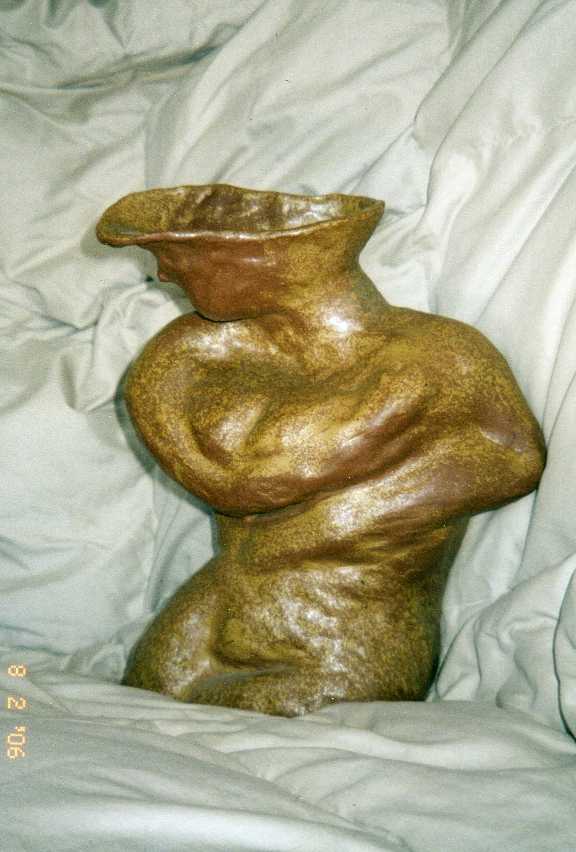
Here it is: a photo of one of my wife's sculptures. It is not my style, but perhaps it is yours.
It's not for sale, by the way.
Tuesday, March 14, 2006
New Blog Ideas
I am considering starting a new blog, one that is more focused. Less about my random thoughts, or my book comments, more about the news and research on a specific topic. I , of course, will still post the latter on this blog, but it would isolate the specific from the non-specific.
Perhaps I will watch a company and look at the products it develops or the law suits its involved in. Perhaps I will research spiders and report all that I can find about them (including Spiderman). Perhaps I will study an author, reading all that I can from that author and post about their lives and books.
I am open to any ideas, but I will quickly shoot them down if I don't like them.
Ready? Comment.
Perhaps I will watch a company and look at the products it develops or the law suits its involved in. Perhaps I will research spiders and report all that I can find about them (including Spiderman). Perhaps I will study an author, reading all that I can from that author and post about their lives and books.
I am open to any ideas, but I will quickly shoot them down if I don't like them.
Ready? Comment.
How Now Shall We Live part 2
The authors take time to discuss major views of Redemption that are competing in our society. One of these is Marxism. They write:
"...Marxism, though largely discrediteed as a political ideology, is still very much alive and well in Western intellectual life. Reborn as multiculturalism and political correctness, it remains one of the most widespread and influential forms of counterfeit salvation. Government-mandated group rights and other outgrowths of multiculturalism are even being read into the U.S. Constitution, so that though original Marxism never took over our nation, this reborn Marxism may yet do so."
I never thought of multiculturalism as a form of Marxism. But it makes sense.
"...Marxism, though largely discrediteed as a political ideology, is still very much alive and well in Western intellectual life. Reborn as multiculturalism and political correctness, it remains one of the most widespread and influential forms of counterfeit salvation. Government-mandated group rights and other outgrowths of multiculturalism are even being read into the U.S. Constitution, so that though original Marxism never took over our nation, this reborn Marxism may yet do so."
I never thought of multiculturalism as a form of Marxism. But it makes sense.
Saturday, March 04, 2006
How Now Shall We Live part 1
I am currently reading the Chuck Colson/Nancy Pearcey(not to be confused with Palose) book on the Christian Worldview and how it relates to culture. Here is a quick summary as to why we shall never reach utopia in our sinful state of being:
"Of course, nowhere has this vision of scientific utopinanism become a reality. And the reason it continually fails is lodged in the logic of the scientific method itself. If we turn human beings into objects for scientific study, we implicitly assume that they are objects to be manipulated and controlled, like scientific variables. That means we have to deny things like the soul, conscience, moral reasoning, and moral responsibility. And when we apply these assumptions to real social problems, we inevitably dehumanize and demoralize people, placing them at the mercy of social scientists in the employ of the technocratic state. The end result is not utopia but another form of despotism."
"Of course, nowhere has this vision of scientific utopinanism become a reality. And the reason it continually fails is lodged in the logic of the scientific method itself. If we turn human beings into objects for scientific study, we implicitly assume that they are objects to be manipulated and controlled, like scientific variables. That means we have to deny things like the soul, conscience, moral reasoning, and moral responsibility. And when we apply these assumptions to real social problems, we inevitably dehumanize and demoralize people, placing them at the mercy of social scientists in the employ of the technocratic state. The end result is not utopia but another form of despotism."
Wednesday, February 22, 2006
Holiday Picture

I am mainly just testing my ability to put pictures on here without picasa. This was our holiday picture. Heather has aspirations for me to post pictures of her art.
Friday, February 17, 2006
Theological Blogs
Some new blogs on Theology.
Together for the Gospel - Various Theologians mingle, including CJ Mahaney.
Blog and Mablog The blog of Douglas Wilson
Crosswalk The blog of Albert Mohler
Together for the Gospel - Various Theologians mingle, including CJ Mahaney.
Blog and Mablog The blog of Douglas Wilson
Crosswalk The blog of Albert Mohler
Saturday, January 28, 2006
Today's Beef with Conservative Talk
Specifically with Laura Ingraham. She has her values mixed up a bit. Of course we are a nation of laws and this nation is not doing enough to enforce those laws. But she uses this line to criticize those who wish to save the lives of those who break the law. I think her main concern is that these maps will provide incentive for people to try to cross the border, that is, encourage people to break the law. That is a fair concern, but at what cost? It seems that she is suggesting that she would rather these people die than that they break the law. She should fight tooth and nail for stronger border patrol, but to trivialize the fact that people are dying trying to find their way to a better life where they can support there families is reprehensible.
I agree with Laura on a lot of things, but here she ends up sounding heartless and arrogant. She does not represent me here. I would hope there are enough conservatives to send a message that this opposition to life is inappropriate and helping people survive does not conflict with a desire to enforce our borders.
The maps, although intent on diminishing the number of deaths, may actually increase them by giving people hope, but not being detailed enough to actually help people. This is my concern with the maps.
Mexico, decided not to distribute the maps after deciding that the maps would give Border Patrol forces a lead as to where to find the illeagally immigrating people. I guess Mexico thinks its better that they die than get sent back.
But Laura praises Mexico for this decision. But, of course, they didn't change their mind for the reason they actually said, says Laura, but because the Bush administration criticized the maps.
By Laura's logic, we have no obligation to help someone in a car wreck if they were breaking the law (speeding) the midst of the accident. Helping them out would simply encourage more people to break our laws.
I agree with Laura on a lot of things, but here she ends up sounding heartless and arrogant. She does not represent me here. I would hope there are enough conservatives to send a message that this opposition to life is inappropriate and helping people survive does not conflict with a desire to enforce our borders.
The maps, although intent on diminishing the number of deaths, may actually increase them by giving people hope, but not being detailed enough to actually help people. This is my concern with the maps.
Mexico, decided not to distribute the maps after deciding that the maps would give Border Patrol forces a lead as to where to find the illeagally immigrating people. I guess Mexico thinks its better that they die than get sent back.
But Laura praises Mexico for this decision. But, of course, they didn't change their mind for the reason they actually said, says Laura, but because the Bush administration criticized the maps.
By Laura's logic, we have no obligation to help someone in a car wreck if they were breaking the law (speeding) the midst of the accident. Helping them out would simply encourage more people to break our laws.
Friday, January 20, 2006
Intelligent Design Blog is Back and Kicking
Here. I happened to check in on it and sure enough, there were a lot of new posts. Apparently Bill Dembski is selectively letting other people moderate and add posts. I may put it back on my links sometime in the future.
Saturday, January 14, 2006
Saturday, January 07, 2006
Monday, January 02, 2006
Finally
I never did post my thoughts on a book I finished. "The Gifts of the Jews" is Thomas Cahill's attempt to show the many ways that the Jews have influenced the world.
I have two objections. First, he picks and chooses what to believe from the Bible with out really substantiating it. It may be basic Theology for him, but he is not writing for Bible scholars. He fails to convince that if I am not going to believe all of the Bible, why I should believe any of it. But neither is he writing for Evangelical Christians, so most people who read it will probably take him at his word here. I don't.
Secondly, he tries to force the ancients into a box of repetition and cycles. I can buy this as typical, but there still seems to be some change, very slow change. Somebody invented a sword. Somebody invented a plow. These changed warfare and farming. His point still remains, that change was slow enough for people to not notice and if there was, they viewed it as a cycle. I am still in doubt.
So what are the gifts? I will try to spell them out.
1. A change from static repetition in cycles to an unmapped changeable future (ie Abraham went)
2. A change from ritual religions to personal relationship with God.
3. An understanding that one must go through the fire of God (either refining or wrath)
4. An expression of the joy and pain of real existence (like the Song of Songs)
He writes, "Most of our best words, in fact--new, adventure, surprise; unique, individual, person, vocation; time, history, future; freedom, progress, spirit; faith, hope, justice--are the gifts of the Jews."
He then ends with a plea for "social justice." It doesn't really fit with the rest of book. It seems more like an addendum suggested by the publisher because they wanted a practical application.
I have two objections. First, he picks and chooses what to believe from the Bible with out really substantiating it. It may be basic Theology for him, but he is not writing for Bible scholars. He fails to convince that if I am not going to believe all of the Bible, why I should believe any of it. But neither is he writing for Evangelical Christians, so most people who read it will probably take him at his word here. I don't.
Secondly, he tries to force the ancients into a box of repetition and cycles. I can buy this as typical, but there still seems to be some change, very slow change. Somebody invented a sword. Somebody invented a plow. These changed warfare and farming. His point still remains, that change was slow enough for people to not notice and if there was, they viewed it as a cycle. I am still in doubt.
So what are the gifts? I will try to spell them out.
1. A change from static repetition in cycles to an unmapped changeable future (ie Abraham went)
2. A change from ritual religions to personal relationship with God.
3. An understanding that one must go through the fire of God (either refining or wrath)
4. An expression of the joy and pain of real existence (like the Song of Songs)
He writes, "Most of our best words, in fact--new, adventure, surprise; unique, individual, person, vocation; time, history, future; freedom, progress, spirit; faith, hope, justice--are the gifts of the Jews."
He then ends with a plea for "social justice." It doesn't really fit with the rest of book. It seems more like an addendum suggested by the publisher because they wanted a practical application.
Sunday, January 01, 2006
Mocking Bird
I bought the new Derek Webb album. David will like the horns. I am very impressed. The only turn off for me is the "war is always wrong" message. I don't think its Derek's purpose to try to make anyone feel guilty for supporting a war. I think he is more interested in pursuading the Christian to take some issues more seriously. War hurts people and we as Christians could show a little more grief and love over those who might be killed, even the enemies.
Lyrics are available here.
Lyrics are available here.
Justin Taylor Blog
Justin Taylor has been working for Desiring God ministries for years. He updates his blog several time a day. There is a lot of Theological and Political information there. It is called "Between Two Worlds" and is linked under the Theological heading, right here, at my blog.
Wednesday, December 28, 2005
Intelligent Design Blog goes into Hibernation
Uncommon Descent will no longer have new posts. I will take it off my links.
Thursday, December 22, 2005
Oil Drilling in Alaska
This article makes a case for the oil drilling in Alaska. The unfortunate thing about the news is that seldom do they cite sources. The news itself is to be considered trustworthy. But when two news sources make equal claims and do not cite sources who am I to trust?
Sunday, December 18, 2005
Relativism in Ancient Greece
Apparently, the Sophists promoted a form a relativism.
This is taken from Western Civilization: The Continuing Experiment by Noble, Strauss, Osheim, Neushel, Cohen, Roberts, and Hecht.
"Protagoras (b. ca. 485 B.C.), perhaps the best-known Sophist, summed up the spirit of the age in his famous dictum 'Man is the measure of all things.' In other words, human beings create the appropriate truth for a given situation--there are no absolute truths. Because they taught respect for success over truth, the Sophists acquired a reputation as word-twisters. Sophist became a term of abuse in Athens and remains so today."
This reminds me of some politicians.
The Sophists were also responsible for Socrates' execution.
This is what some like to think Protagoras looked like:
This is taken from Western Civilization: The Continuing Experiment by Noble, Strauss, Osheim, Neushel, Cohen, Roberts, and Hecht.
"Protagoras (b. ca. 485 B.C.), perhaps the best-known Sophist, summed up the spirit of the age in his famous dictum 'Man is the measure of all things.' In other words, human beings create the appropriate truth for a given situation--there are no absolute truths. Because they taught respect for success over truth, the Sophists acquired a reputation as word-twisters. Sophist became a term of abuse in Athens and remains so today."
This reminds me of some politicians.
The Sophists were also responsible for Socrates' execution.
This is what some like to think Protagoras looked like:

Monday, December 05, 2005
Elephants
A blog I ran into speaks about elephants and blind men.
Pensees: The Parable of the Blind Men and the Elephant: Does it Work?
Pensees: The Parable of the Blind Men and the Elephant: Does it Work?
Saturday, November 26, 2005
New Derek Webb CD
Mocking Bird.
"She Must and Shall Go Free" is about Jesus and the Church. This one's about proclaiming the Kingdom.
Here's an inciteful interview about the album.
"She Must and Shall Go Free" is about Jesus and the Church. This one's about proclaiming the Kingdom.
Here's an inciteful interview about the album.
Tuesday, November 22, 2005
Beautiful Savior vs. Fairest Lord Jesus
I found this intriguing: "Beautiful Savior" in the Psalter hymnal comes as "Fairest Lord Jesus" in other hymnals. I am not sure of the reasons for this change, but I suspect that the Psalter editors didn't like the lyrics in the first verse, so they threw them out, renamed the song, and modified several other lyrics. I honestly don't know which is the original or classic version, but I have seen the Psalter change the original before. Judge for yourselves.
This is what I grew up with in "Praise! Our Songs and Hymns":
Fairest Lord Jesus
Fairest Lord Jesus! Ruler of all nature!
O Thou of God and man the Son!
Thee will I cherish, Thee will I honor,
Thou my soul's glory, joy and crown.
Fair are the meadows, Fairer still the woodlands,
Robed in the blooming garb of spring:
Jesus is fairer, Jesus is purer,
Who makes the woeful heart to sing.
Fair is the sunshine, Fairer still the moonlight,
And all the twinkling storry host:
Jesus shines brighter, Jesus shines purer
Than all the angels heav'n can boast.
Beautiful Savior! Lord of the nations!
Son of God and Son of Man!
Glory and honor, Praise, adoration
Now and forevermore be Thine!
Here is the Psalter's rendition:
Beautiful Savior
Beautiful Savior! King of creation!
Son of God and Son of Man!
Truly I'd love thee, truly I'd serve thee,
Light of my soul, my joy, my crown
Fair are the meadows, fair are the woodlands,
robed in flowers of blooming spring;
Jesus is fairer, Jesus is purer;
he makes our sorrowing spirit sing.
Fair is the sunshine, fair is the moonlight,
bright the sparkling stars on high;
Jesus shines brighter, Jesus shines purer
than all the angels in the sky.
Beautiful Savior! Lord of the nations!
Son of God and Son of Man!
Glory and honor, praise, adoration,
now and forevermore be thine!
This is what I grew up with in "Praise! Our Songs and Hymns":
Fairest Lord Jesus
Fairest Lord Jesus! Ruler of all nature!
O Thou of God and man the Son!
Thee will I cherish, Thee will I honor,
Thou my soul's glory, joy and crown.
Fair are the meadows, Fairer still the woodlands,
Robed in the blooming garb of spring:
Jesus is fairer, Jesus is purer,
Who makes the woeful heart to sing.
Fair is the sunshine, Fairer still the moonlight,
And all the twinkling storry host:
Jesus shines brighter, Jesus shines purer
Than all the angels heav'n can boast.
Beautiful Savior! Lord of the nations!
Son of God and Son of Man!
Glory and honor, Praise, adoration
Now and forevermore be Thine!
Here is the Psalter's rendition:
Beautiful Savior
Beautiful Savior! King of creation!
Son of God and Son of Man!
Truly I'd love thee, truly I'd serve thee,
Light of my soul, my joy, my crown
Fair are the meadows, fair are the woodlands,
robed in flowers of blooming spring;
Jesus is fairer, Jesus is purer;
he makes our sorrowing spirit sing.
Fair is the sunshine, fair is the moonlight,
bright the sparkling stars on high;
Jesus shines brighter, Jesus shines purer
than all the angels in the sky.
Beautiful Savior! Lord of the nations!
Son of God and Son of Man!
Glory and honor, praise, adoration,
now and forevermore be thine!
Common Latin Phrases
Saturday, November 12, 2005
Expensive art

I can't say I understand why this is valueable art. Probably a lot of factors, and a lot of art factors I don't understand. There seems to be this elite art culture that can tell what "good" art is, while the rest of us scratch our heads. To me it seems subjective in part. I do think there is a lot I would need to study about art before I understand why this is valuable, but then, the artists these days are painting for the elites. As a non-art-elite, I see no reason why I should value this art at all. I don't think it is absolutely ugly. I might look at it and say, hmmm. But if I didn't know better, I'd think somebody forgot to finish it, or that there was just excess paint on piece in front of it.
Friday, November 04, 2005
CSI Joins the Embrionic Stem Cell Debate
Last night's CSI episode included a confrontation between Catherine Willows and the head of an organization that finds surrogate mothers for leftover embryos from in vitro fertilization. Willows tends to be arrogant and snappy, and this episode followed suit.
Two obsevations about the encounter:
1. Willows had the upper hand in the confrontation. She referenced a Pope from the 1600's who stated that life begins when the mother can sense movement. The other woman (I will call her the nurse) could only resort to the weak post modern retort, "Thats just your view." When the nurse had clearly lost the arguement, she was unhelpful to the investigators because Willows' statements were stated disrespectfully.
2. When Grisom reprimanded Willows for her conduct, he actually gave her advise for a stronger argument. He quoted a verse from the Bible about blood being the determiner of human life.
Basically, this episode manipulates the viewer into thinking that the normal, and intelligent people have no problems with killing embryos, and that those who are against it are unintelligent and have no basis for it beyond their faith. They also use strawman arguements which give a very slanted presentation of the issue. It may well be that the writers have only had confrontations with prolifers like the nurse, but this still sets back the prolife movement since many people who watch CSI will never hear the real prolife response to Willows' and Grisom's arguments.
What are those responses? Well, basically, I don't give a lot a weight to the pope. And, if I remember correctly, the life blood verses in scripture refer more to a means of seeing who has died, or to dietary laws. The reason to oppose stem cell research is that the embryo is a human in an early form of development (this cannot be refuted successfully) and should be respected of its right to life (this is what is disputed here). I do not see how one can come to the conclusion that killing a human at a particular age is moral without drawing arbitrary lines in the sand. They may be informed lines, and there may be reasons behind it, but they are not difinitive. It is a prefrence to think that human life is only worthy if brain waves are flowing. It is a prefrence to think that we can kill humans if they have yet to get blood pumping. Why can I not then prefer to kill my two year old for the reason that his sexual organs are not yet developed? For this reason I think those artificial lines in the sand are absurd.
Two obsevations about the encounter:
1. Willows had the upper hand in the confrontation. She referenced a Pope from the 1600's who stated that life begins when the mother can sense movement. The other woman (I will call her the nurse) could only resort to the weak post modern retort, "Thats just your view." When the nurse had clearly lost the arguement, she was unhelpful to the investigators because Willows' statements were stated disrespectfully.
2. When Grisom reprimanded Willows for her conduct, he actually gave her advise for a stronger argument. He quoted a verse from the Bible about blood being the determiner of human life.
Basically, this episode manipulates the viewer into thinking that the normal, and intelligent people have no problems with killing embryos, and that those who are against it are unintelligent and have no basis for it beyond their faith. They also use strawman arguements which give a very slanted presentation of the issue. It may well be that the writers have only had confrontations with prolifers like the nurse, but this still sets back the prolife movement since many people who watch CSI will never hear the real prolife response to Willows' and Grisom's arguments.
What are those responses? Well, basically, I don't give a lot a weight to the pope. And, if I remember correctly, the life blood verses in scripture refer more to a means of seeing who has died, or to dietary laws. The reason to oppose stem cell research is that the embryo is a human in an early form of development (this cannot be refuted successfully) and should be respected of its right to life (this is what is disputed here). I do not see how one can come to the conclusion that killing a human at a particular age is moral without drawing arbitrary lines in the sand. They may be informed lines, and there may be reasons behind it, but they are not difinitive. It is a prefrence to think that human life is only worthy if brain waves are flowing. It is a prefrence to think that we can kill humans if they have yet to get blood pumping. Why can I not then prefer to kill my two year old for the reason that his sexual organs are not yet developed? For this reason I think those artificial lines in the sand are absurd.
Thursday, November 03, 2005
Tuesday, November 01, 2005
"Living" Constitution
It is a hard thing to amend and modify the Constitution. The founders made it that way, to ensure that a large portion of the population is sure that they want that change. The Constitution was even quite controversial in its ratification. It was a compromise to get, not just a majority, but a super-majority.
Because of this, I find it hard to believe that the framers were concerned about leaving things in the Constitution vauge enough for a future court to interpret new meaning into the document, like "right to privacy." If they went through such pains to get it ratified initially, new rights and application of rights should also go through the agonizing process of debate and ratification in order to be added.
Currently, the Supreme court puts new meaning into the Constitution by abstracting concrete and specific rights, and generalizing them to apply to other concrete situations. This adds new rights and takes away other rights to their whim and reasons. But in effect, this is the equivalent of a revolution. Rather than take up arms, demand a change, and work something out amongst the survivors, they are wiggling their pens in the name of progress to make a new Constitution; one that has not been ratified by a super-majority.
Because of this, I find it hard to believe that the framers were concerned about leaving things in the Constitution vauge enough for a future court to interpret new meaning into the document, like "right to privacy." If they went through such pains to get it ratified initially, new rights and application of rights should also go through the agonizing process of debate and ratification in order to be added.
Currently, the Supreme court puts new meaning into the Constitution by abstracting concrete and specific rights, and generalizing them to apply to other concrete situations. This adds new rights and takes away other rights to their whim and reasons. But in effect, this is the equivalent of a revolution. Rather than take up arms, demand a change, and work something out amongst the survivors, they are wiggling their pens in the name of progress to make a new Constitution; one that has not been ratified by a super-majority.
Sunday, October 30, 2005
Book on Isreal/Palestine Conflict
I am currently reading From Time Immemorial: The Origins of the Arab-Jewish Conflict Over Palestine. This is one I started a long time ago but never finished. I am picking up where I left off.
The book essentially refutes much of the conventional wisdom on the conflict in "Palestine." She is not a historian, but a journalist. She did a lot of research for this and sites many original sources. As I am not a Historian, I am going to try to be skeptical of this book, but I am an empty slate on this history.
Here is a quote from a recent section I read:
"The disparate peoples recently assumed and purported to be 'settled Arab indigenes for a thousand years" were in fact a "heteroeneous" community with no 'Palestinian' identity, and according to an official British historical analysis in 1920, no Arab identity either: 'The people west of the Jordan are not Arabs, but only Arabic-speaking. The bulk of the population are fellahin.... In the Gaza district they are mostly of Egyptian origin; else where they are of the most mixed race.'
The book essentially refutes much of the conventional wisdom on the conflict in "Palestine." She is not a historian, but a journalist. She did a lot of research for this and sites many original sources. As I am not a Historian, I am going to try to be skeptical of this book, but I am an empty slate on this history.
Here is a quote from a recent section I read:
"The disparate peoples recently assumed and purported to be 'settled Arab indigenes for a thousand years" were in fact a "heteroeneous" community with no 'Palestinian' identity, and according to an official British historical analysis in 1920, no Arab identity either: 'The people west of the Jordan are not Arabs, but only Arabic-speaking. The bulk of the population are fellahin.... In the Gaza district they are mostly of Egyptian origin; else where they are of the most mixed race.'
Thursday, October 27, 2005
Harsh Words
Iranian Wants Israel 'Wiped Off the Map' - October 27, 2005 - The New York Sun - NY Newspaper.
Rome wanted to do this once. And they renamed it Palestine.
Rome wanted to do this once. And they renamed it Palestine.
Monday, October 24, 2005
Hugh Hewitt On Reading
From "In But Not Of:"
First, to scare you: after recommending about 14 books, Hugh says,"Fourteen volumes may seem like a lot, but they are not. In fact, that number should be a small portion of the reading you routinely do over the course of a year."
Second, the suggestion: Hugh says, "The world is full of terrible books, both those that are time wasters and those that are deeply, horribly wrong about the way the world works and how it came to be this way. The first sort are mistakes, but the latter can be deadly. Which is why there is no such thing as an innocent suggestion of a book to read." He is refferring to the writings of Marx and Hitler. He goes on, "So it is best to get your suggestions from reliable individuals--individuals whose charater impresses you as much as their intellect."
Any book recommendations?
First, to scare you: after recommending about 14 books, Hugh says,"Fourteen volumes may seem like a lot, but they are not. In fact, that number should be a small portion of the reading you routinely do over the course of a year."
Second, the suggestion: Hugh says, "The world is full of terrible books, both those that are time wasters and those that are deeply, horribly wrong about the way the world works and how it came to be this way. The first sort are mistakes, but the latter can be deadly. Which is why there is no such thing as an innocent suggestion of a book to read." He is refferring to the writings of Marx and Hitler. He goes on, "So it is best to get your suggestions from reliable individuals--individuals whose charater impresses you as much as their intellect."
Any book recommendations?
Friday, October 21, 2005
Thoughts on "In But Not Of"
I am reading Hugh Hewitt's In, But Not Of : A Guide to Christian Ambition.
I am enjoying the book, and although it is geared more for high school Juniors and Seniors, I will probably end up heeding some of his advise.
The thing that disappoints me is that he is inconsistent. He began the book by giving an example of three people who influenced the world the most in a positive way (i.e. defeating the spread of Communism) in the last century: Pope John Paul II, Ronald Reagan, and some Russian author critical of the USSR (not Ayn Rand). I am not convinced that any of these people followed Hugh's advise. Now, he does qualify that as Americans, our best bet is to influence Westerners, and thus goes on to say how to gain influence over Westerners.
And what about Bono? Sure his foreign policy is a bit flawed (i.e.. let's subsidize corrupt governments), but his did a lot of good in Ireland and no one can reach more people about the plight in Africa. He probably broke every rule in Hugh's book. Had he followed them, I doubt he would be as influential.
Despite this inconsistency, the book does carry wisdom and is easy to read.
I am enjoying the book, and although it is geared more for high school Juniors and Seniors, I will probably end up heeding some of his advise.
The thing that disappoints me is that he is inconsistent. He began the book by giving an example of three people who influenced the world the most in a positive way (i.e. defeating the spread of Communism) in the last century: Pope John Paul II, Ronald Reagan, and some Russian author critical of the USSR (not Ayn Rand). I am not convinced that any of these people followed Hugh's advise. Now, he does qualify that as Americans, our best bet is to influence Westerners, and thus goes on to say how to gain influence over Westerners.
And what about Bono? Sure his foreign policy is a bit flawed (i.e.. let's subsidize corrupt governments), but his did a lot of good in Ireland and no one can reach more people about the plight in Africa. He probably broke every rule in Hugh's book. Had he followed them, I doubt he would be as influential.
Despite this inconsistency, the book does carry wisdom and is easy to read.
Tuesday, October 04, 2005
Commerce Clause
The commerce clause in the US Constitution give Congress power "regulate commerce with foreign nations and among the several States." Before the 1942 reading of this clause, the Federal government was very limited on what laws it could impose by the 10th ammendment which states, "The powers not delgated to the United States by the Constitution, nor prohibited by it to the States, are reserved to the States respectively, or to the people."
After 1942, all a lawmaker needs to do to "override" the 10th ammendment is to show how a law will affect commerce between states. There are not many restrictions that won't somehow affect commerce between states so this makes the scope of the commerce clause limitless.
Michael MCConnell once wrote to show the absurdity of overreaching federal law, "Assume there are only two states, with equal populations of 100 each. Assume further that 70 percent of State A, and only 40 percent of State B, wish to outlaw smoking in public buildings. The others are opposed. If the decision is made on a national basis by a majority rule, 110 people will be pleased, and 90 displeased. If a separate decision is made by majorities in each state, 130 will be pleased, and only 70 displeased. The level of satisfaction will be still greater if some smokers in State A decide to move to State B, and some anti-smokers in State B decide to move to State A.
I read about this concept in Mark Levin's "Men in Black". I fell in love with the 10th ammendment, and I hope for its return, even if it means that the pledge is recited in some states and not others.
After 1942, all a lawmaker needs to do to "override" the 10th ammendment is to show how a law will affect commerce between states. There are not many restrictions that won't somehow affect commerce between states so this makes the scope of the commerce clause limitless.
Michael MCConnell once wrote to show the absurdity of overreaching federal law, "Assume there are only two states, with equal populations of 100 each. Assume further that 70 percent of State A, and only 40 percent of State B, wish to outlaw smoking in public buildings. The others are opposed. If the decision is made on a national basis by a majority rule, 110 people will be pleased, and 90 displeased. If a separate decision is made by majorities in each state, 130 will be pleased, and only 70 displeased. The level of satisfaction will be still greater if some smokers in State A decide to move to State B, and some anti-smokers in State B decide to move to State A.
I read about this concept in Mark Levin's "Men in Black". I fell in love with the 10th ammendment, and I hope for its return, even if it means that the pledge is recited in some states and not others.
Subscribe to:
Posts (Atom)